Monday, November 18, 2013

Out of the Blue Exchange

The Homeland Treat That's Poisoning 90 Million Americans
http://drmicozzi.com/category/daily-dispatch


I found this in my email from a dear Midland, MI friend.  Although I only lived there a year, I still feel the love from the church members there.  It has been over six years since we have spoken.

I had to double check to see if she was even a facebook friend.  I know I don't get any "like"s or comments from her, most likely because she and her husband are very involved in republican politics.  It turns out we ARE facebook friends, and she decided long ago not to follow my posts....which I really appreciate, in a way, because if someone doesn't agree with me, I really don't want to hear about it.  I don't need to know, because it consumes me with worry.  And I don't like to fight.

You would think I would just choose the popular opinions to avoid confrontation.

But nobody can tell me I don't know what I know.

So, I get this strange email, that seems at first to be in support of what I already know, that Tylenol does more harm than good, and I was about to send a quaint reply.  I decided I should probably read a bit more closely....and sure enough, it's propaganda from the pro-vaxers.

No...you see...you missed it!  It was SO obvious!  You THINK it was the vaccines??  (insert chuckle here with a pat on the back)  Nooooo.....(big grin) it was the TYLENOL you gave your child BEFORE he got his shots! 

I politely replied to my friend as follows:

Thanks, Annette :) As a community, we have known the dangers of Tylenol for quite some time, as it inhibits glutathione. Tristen's vaccine injury was at two days of age at the hospital where he was not given any Tylenol before hand. I believe since we are all individuals, one cannot say only one thing or only another thing will for certain cause autism. We must understand the human body and how the immune system works and do everything in our power to keep our children healthy. I am truly blessed to be able to rely on the spirit to guide me so I can make the best decisions possible for my children :)
Have a blessed day!
 
Her response:
 
Agreed. There is never just one answer, since we are all individual and have different
individual plans from Heavenly Father. You're a great mom!
 
 
I try very hard not to judge other's parenting decisions....none of the decisions I have made for my children have been easy.  We may see situations differently.  In the end, we have to live with our decisions and be able to justify them to God.  I'm just doing the best I can.  It has taken me a long time to learn and become comfortable with the fact that at any moment I have to be prepared to defend my decisions.  They come out of the blue from anywhere at anytime.  Even when I think I'm safe from judgement.
 
 
I wish I was stronger.  I wish I was as brave as so many of the Mother (and father) Warriors out there who take on so much criticism and never give up for their kids.  They are doing it for my child....and they are doing it for all the children in the world.  I am blessed to be inspired by them. 


Thursday, November 7, 2013

What We've Tried and Liked The Most

So what has helped Tristen the most over the past 15 years?

First, was my ability to be a stay at home mom.  Not everyone gets this chance, but I was very blessed.  Because of this, I was able to be his primary and almost sole care giver before he started school, and I could apply what I learned from my classes in the Hannen Program for understanding non-verbal wants and needs and also continue the speech and teacher services he received consistently.

Second....Diet.  No doubt...it seems too simple and yet too difficult at the same time.  But we saw eye contact and response to people we had not seen before.  Also, health issues, like wetting the bed, rashes and allergy symptoms vanished.

Next, glutathione cream.  We saw increased speech and cognition. 

IV chelation.  We knew we were taking a risk, but had read about it in detail and were confident in the medical staff's knowledge.  Tristen jumped from a first grade reading level to a fourth grade reading level in a a matter of weeks.  His urine output results showed he was passing aluminum, uranium, and cadmium, among others,  at shocking levels.  We saw a small amount of mercury removed.

Chiropractic.  The "arc of life" is basically the curve of your neck, and when x-rayed from a side view, one can measure the degree of the arc, which is typically at 43 degrees for optimal health.  Tristen's arc was at a -3.  His neck was actually curving the opposite way and cutting off his brain's ability to talk to the rest of his body.  He tended to rest his head on his back and look down his nose at things.  After only a few adjustments, he was looking straight on at the world.  He looked better.  He felt better.  He lost some of his autistic characteristics and became more friendly, sociable, and easy going.

"The curve in the neck is considered the most important, and has been referred to as the arc of life. This is a term coined by a neurosurgeon due to the importance of the cervical curve and the structure it protects – your nervous system. All of the nerves which control your arms, legs, torso and every one of your internal organs must flow through this area. A pinched nerve in the neck can affect every part of your body.
Alfred Brieg, MD stated that “Loss of the cervical curve (arc of life) stretches the spinal cord 5 to 7cm and produces pathological tension, putting the body in a state of disease.” Multiple studies have shown that a loss of this curve reduces lung capacity by up to 30%; decreased lung capacity has been linked to COPD, heart disease and cancer. Renee Calliet, MD concluded that “decreased curves and abnormal spinal position affects the heart, lungs and digestive system.”
http://doctorcathyw.wordpress.com/2010/04/14/the-arc-of-life/

HBOT:  We did forty dives in one month.  Tristen started talking about his past.  He was sharing memories with us from when he was four years old.  He was calmer and less distracted.

NeuroProtek:  The blend of bioflavanoids have helped Tristen with is verbal expression.  He is talking in more complete sentences, and using more age appropriate language.  He is wanting to share his thoughts, ideas, likes and dislikes with his family.  He is enjoying writing in his journal daily...writing his own sentences and getting more spelling, punctuation and grammar correctly than previously.

Essential Oils:  Good things are beginning to emerge....I will keep you posted :D


In my perfect world, I would have a large house for young adults on the spectrum.  I want to take the burden off the parents who constantly worry about their children's future after they age out of High School.  I would train my staff to listen, have patience and to be calm and consistent with to those who are entrusted to their care.  We would have a garden to grow and prepare our own food and we would teach the children why clean food is important.  We would eat diets that consisted of fresh clean foods.  We would eliminate wheat, dairy and soy for sure.  I would have an Hyberbaric Oxygen Tank in our basement for the residents to use each day.  They would get chiropractic care every week. 

That's my kind of heaven :)

Wednesday, November 6, 2013

What a Day of Homeschooling Looks Like for Us

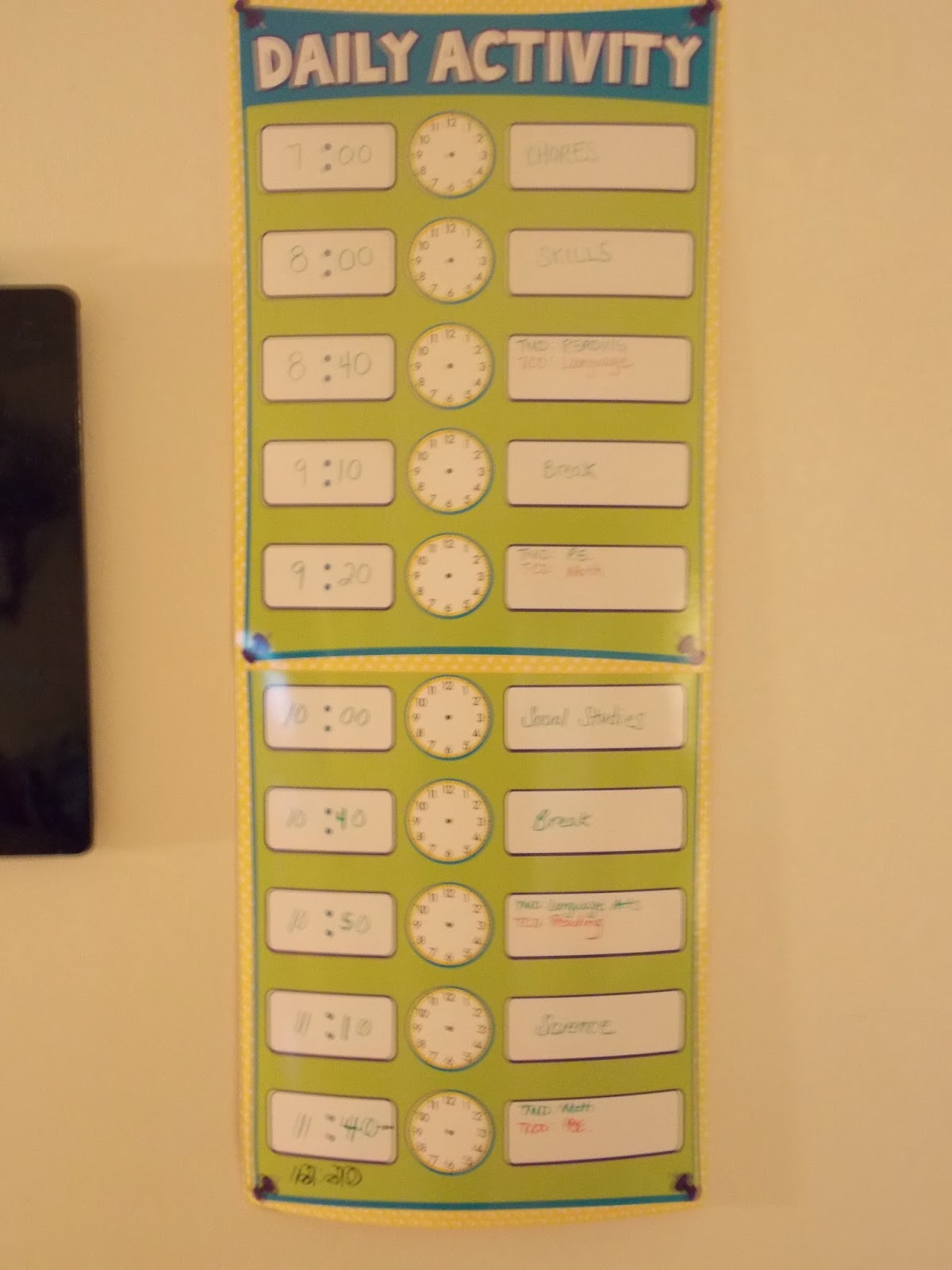
We start our morning at 5:20 a.m.
Tristen and I get dressed, eat breakfast, and take our vitamins and supplements.  Tristen starts his chores, and we head out the door to be at Seminary by 6:30.  This is a church class for kids in High School where we study scripture.  Here we practice social skills, answering questions, making eye contact, and paying attention in general.  Tristen gets stickers and after he gets five  he earns a special cookie.
 
We start our first class at 8:00, so when we get home from seminary, I do prep for the day and the kids get their chores done.  They do things like sweeping, vacuuming, dishes, dusting, dishes, bathrooms, feeding and watering pets, and personal hygiene.
The State of Texas guidelines for homeschooling is very vague.  You can obtain a curriculum from any source; used books, workbooks and/or computer or video screen; teach reading, spelling, grammar, math and a study of good citizenship.
 
To ensure a study of good citizenship, the boys participate in the Boy Scout program through our church.  We also have discussions during different units in our Social/Life Skills class.
 
Social Skills:  We watch videos on proper social interaction.  We talk about properly responding when someone talks to you.  We bake/prepare food and make personal care products.  The unit we are on now, we are tackling sensory obstacles by using Essential Oils, dry brushing while listening to various composers.  We made booklets about the benefits of "super-foods" and home-remedies.
 
Reading:  Tristen has been using the "Ask Me" book series which is mostly about science.  It takes us four days to read and discuss the book.  If he gets excited about a topic and wants to learn more, we go to the Internet to learn more.  On Friday, he does a worksheet with questions from the book that I grade as a quiz. 
During Tristen's reading time, he needs me one-on-one, so I have Tanner do the 8th grade curriculum from Time4Learning.com Language Arts and LA Extensions on the computer.
 
P.E.:  I use the Texas Learning Essentials to guide me in building a curriculum that benefits both of my children.  They do 30 minutes of a workout on the treadmill every day.  While exercising, they watch educational shows about health and wellness.  Then, they do chiropractic neck and spine exercises to better keep them aligned. 
 
Math:  Tanner is able to continue with the Time4Learning website in the Honors Algebra program.  He is very independent with few questions.  He does lessons, worksheets, quizzes and tests.  I go over his grades and we re-do lessons together if he did not understand the material.
For Tristen, Math is a strong point, but he is still not at grade level.  Some things he gets extremely easily and does without assistance.  Other concepts are too difficult and I help him though.  We have used Khan Academy online, and Elementary Advantage Advanced Math for 4th, 5th, and 6th graders, and because it is at his level, and he is able to be tested and get a C or above unassisted.  We also do money skills every Friday.
 
Social Studies:  I had a hard time finding an appropriate program for Tristen he could do independently.  Much of what he read he did not understand or retain.  Tanner, using the Time4Learning program, was having the same trouble at his grade level.  I decided to combine them and teach this class myself, using the text, worksheets, quizzes and tests from the website, but I modify them for Tristen and explain more in discussion form for Tanner.  Both of their attitudes have changed and they are now enjoying our discussions about the history of the country and are much more cooperative.  Tristen surprises me everyday with how much he understands!
 
Language Arts:  Tristen works on journaling, spelling words, building sentences, typing and writing his comic book.
 
Reading for Tanner:  Tanner struggled a lot in public school with reading.  He was not very cooperative in homeschool either, until I had him read to me aloud.  Now he is excited about sharing his book with me, making connections and predictions.  He is becoming a more fluent reader and he is not so afraid of reading.
 
Science:  We use a few different computer programs and learn together as a team.  Texas Learning standards have 8th graders doing a lot of experiments, so that is our focus.  The boys love science and enjoy the hands on interaction.
 
We end our school day at 12:20 for a couple of very important reasons. 
1.  It does not take as much time to teach a subject to two students as you would need to teach a whole class.  Being one on one enables us to move on more quickly when I am sure they have a concept, rather than spending a lot of time waiting for everyone to "get it".
 
2.  It is difficult for kids with special needs to spend much more than a half hour on a subject at a time.  I know this from my experience as a paraprofessional and from teaching Tristen this past 15 years.  Tanner also has a very hard time staying on task and is much more focused with a shorter time frame.
 
3. When Tanner was in a public Montessori school last year, they did all their work in the mornings and the afternoons were "free time".  This is a common practice, and because of this, I feel our school day is appropriate.
 
4.  Many times children with disabilities spend their days with little to no expectations.  They go from one place to the next without having to do any work or have academic accountability.  Tristen is learning much more than he ever has and is expected to stay on task and learn rather than to sit and daydream.
 
We hold classes the same days and have vacation the same days as the public schools.  What you may not know about public school, is that they can have a late start or early release and still count that day as a full day of school.  We, of course, do not do early release days as they do here in town. 
There is also "free" time to be considered in public school, such as lunch and recess.  That is counted as part of the school day, including assemblies, field trips, morning meeting, PBIS activities where they learn the school rules, centers and story time (for young children),  music, art, classroom parties for holidays, etc.  There is arguably time "wasted" in school that we do not have to account for in our homeschool program.
 
The kids are exhausted and in bed by 8:30pm.
 
This is just a short list of what we have been accomplishing in the past 9 weeks.  I am so happy to see my children happy and learning, without the bullying and politics in a public school setting.


Monday, October 28, 2013

What I Wish They Knew

When your child starts to fall behind the averages of his peers, it can be alarming.  You may start to worry if and when the child will catch up.  In the event your child is diagnosed with autism, you will look for therapy in hopes to catch him up to what is appropriate for his age level.   And although you may see progress over the months, the rate of progress can be slow.
When your child is around age two, he may not look so different from other two-year-olds.  Maybe he doesn't talk, and runs around wildly in circles, but he is still at the adorable toddler stage, where most on-lookers smile warmly in an understanding sort of way.  (Sometimes you get the "you are a horrible parent" looks, but hopefully not as often.)
As your child grows and reaches age 4, he may be in a special needs classroom, where he may seem to be one of the higher functioning.  As a parent, you focus only on his gains and progress and forget about "the gap".
The gap is where your child is compared to where other children his age are developmentally.  When they are cute, silly, kindergartners, their delays are more prominent, but still the child is mostly quirky and enjoyable and their behavior is more acceptable.
The gap becomes more apparent by about third grade.  Your child may have lost the chubby cheeks of their youth, but still love to play with Thomas the Tank Engine, while the other boys and girls in the regular education classrooms are looking for boyfriends and girlfriends.

I've watched my son progress, but as the years pass by the gap gets larger and more noticeable after a brief introduction.  It is hard for him to read, and people are not quite as loving and understanding to a fifteen year old with pimples and a hint of a moustache.  They act uncomfortable.

Even the nicest people, who would never be unkind....are sort of scared, and don't know what to say or how to react.  Tristen doesn't notice it, but I do....and it breaks my heart. 

This is what I wish they knew:

Include him, while understanding that in his attempts, the task may take longer and may not be done quite right.  There may be some instances where things have to be done quickly and/or perfectly, but most of the time, these are only perceptions in our own minds.

Be flexible and understanding.  Give him the choice to participate...gently encourage him to do so, but leave it ultimately up to him.

Remember that in his mind he is still a young child.  Think about how you would treat a younger sibling or cousin.  This is difficult as he grows older on the outside, but not so much on the inside.

Understand that he does not make eye contact or respond to questions easily, and it will take time for him to be comfortable and do so independently.  Don't let this discourage you from communicating!  He likes being noticed, but is embarrassed by it at the same time.

Don't laugh at him when he is being serious. If he is trying to tell you something and mixes up his words, or if he is reading...please be attentive and don't laugh.  There are times when he is silly and having fun, and it would be appropriate to laugh with him, just not "at" him.

I sincerely feel people just don't know....no one has explained to them how to talk to a young adult with autism. We need to get the word out, because they are going to need the experience.


Wednesday, October 23, 2013

Clarification

I feel I have to clarify.
I am not a conceited person.  I am quite the opposite.  I have a difficult time admitting I do ANYTHING well....I constantly self evaluate and self criticize.
If my children make it into functioning adults who contribute to society, it will be in spite of me.
However, I would be remiss to not say my unique parenting and parenting choices have not helped my children thus far.  I also can not deny being led by my Father in Heaven.  It is as true to me and as deep and real as my love for my children.
I couldn't have accomplished what I have without Him.  I would not have the gift of instinct to go down the right paths for my family's health.  I would not have the blessing of seeing autistic children's strengths and the unique ability to understand how to teach them.  I see things and understand things other educators don't see.  I owe it to God and can not take credit for it with a clear conscience.
I hope and pray the things I have learned will be useful to other families facing the same challenges.

Tuesday, October 22, 2013

Shoulda Woulda Coulda's

In typical "Meadow" fashion I have been continually going over my interview with the girls from Truther Talk blogradio.
Before the interview, I prepared.  I "met" with hosts April Boden and Virstyne Henry via Skype...I've known April for a few years now, but it was nice to get reacquainted.
I went over key topics in my mind.  I wanted to be sure I was mentally prepared for topics.  I went over books, and essays, and articles.
In the time between the pre-interview and interview, my health plunged quickly, spiraling downward and seemingly out of my control.  I seriously contemplated cancelling, but then I would have to admit what was happening, and that was too scary.  I chose to fight to regain my health.  (That's another story)
We made a few scheduling changes, and by none other than the grace of God, I regained my strength and ability, for the most part, to participate in this interview.
Although I've been doing this blog for quite a few years, and divulge personal stories, sadness, and triumphs.....I was most worried about how the listeners would evaluate me.
First thing to hate (on my list), is my accent.  I HATE talking like a Wisconsinite...truly...and am more than happy to chime in with the y'alls down here in Texas.  I worried about my pronunciation.  I was worried if I would say "steeevia" or  "steh-via".
Then, I worried I would go off topic, or forget to completely answer a question (which I did).
I worried I would lose my train of thought (which I did) and forget my point (which I did).

Without a degree or career-years under my belt, I also worry people will say I lack credibility, which is what really gets to me. 

I have been doing this autism thing for 15 years.  Me.  Not therapists, not ABA.  Not books, not groups.  Me.  And I think Tristen is an outstanding young man. No sitters, no respite.  And very little spousal support.
A blend of spiritual guidance, and daily non-stop practice with my own autistic son, made me an excellent paraprofessional because that experience gave me a unique way of understanding autistic children.  This can not be learned in an autism training class and does not come with a degree to hang on my wall.
It's just me.  Doing what makes sense.  Caring endlessly for children with autism.  And giving it my all.
I am so blessed to have Truther Talk air some of my personal journey.  I feel guilty that I said the wrong things or should have said more...or less....but the time to worry is over.
The truth is, these are the facts of my life, whether interesting or not....it is what it is.  I share them in hopes of helping others.
So, I have decided to launch a new blog....
I want to keep true to "Autism and Health".  I want it to be a place where caregivers can go and get ideas of different methods for helping autistic children.
"The Green Bean Girl" is going to be more about me, my political opinions, rants, irritations, or questions in general.  Also, I am going to track my health journey. 
I will continue to keep up with Tristen's health, and in all reality, it is intertwined.  It is hard to take "Meadow" out of autism, because so much of who I am is because of autism.  But I feel strongly I should have a more neutral blog for people who want to help autistic individuals, and I don't want them leaving the site as soon as they see something political.
Anyone interested in both can find more at http://greenbeangirl34.blogspot.com/
And check out my interview with the lovely ladies from Truther Talk on 11/6 !!!
 http://www.blogtalkradio.com/truthertalk

Wednesday, October 16, 2013

"Is that what happened to me?"

   Those of you familiar with my blog know I don't treat Tristen like he has autism.  He and his brother have the same expectations.  We don't excuse him from responsibility.  When Tanner has asked us questions about his brother, we tell him he has a more difficult time learning than he does.  We don't go into detail...ESPECIALLY causation.  It's a tough enough world out there for an adult who proclaims their child was vaccine injured.  You have to have the facts to back up your statement, and my kids don't remember all the facts.  They know we don't get shots because the ingredients in them are toxic, and their immune systems are not strong enough to combat them.  This eases their minds and they feel good about it.
    But I've never said, out loud, in front of my autistic son that his brain was damaged by a vaccine.  I never explained the exact ingredients in vaccines that are dangerous.....until yesterday.

   The boys are studying the periodic table in science class.  Tanner is telling Tristen how he had to do a report last year in school on Mercury.

"Yeah, supposedly the mercury in thermometers was poisonous, so they stopped using it.  I couldn't even read a lot about it or find pictures of anything interesting because everything was blocked on the school's computer.  I don't even know if Mercury really is poisonous."

I explained to him the history of the men who used to make hats out of leather.  I told them how they used mercury to treat the leather before they sold it to people.  I asked them if they remembered the "Mad Hatter" from Alice in Wonderland.  They said they did.  I told them that was where the saying came from...."Mad as a Hatter" because the "Hatters" or the men who made hats started acting silly and goofy.

Tristen says..."Wait, Mom....is that what happened to me?"

How do you answer that?  Can I be sure it was the mercury in the vaccine?  Or was it just the vaccine in general given at two days old that caused his encephalitis?  Or was it a combination of having the vaccine at two days old and then nursing from a mother who had just received the MMR?  We will never know for sure, all we DO know is the symptoms of regression were clear after that vaccination.

I said,  "Do you think you are silly like the Mad Hatter?"

"Sometimes." He said very seriously....he stared to the side....deep in thought.

I wish I could give him a definite answer.  In my mind, it doesn't really matter exactly, because we are healing him now the best way we know how. 

How will this effect his self image? 

After leaving the conversation alone for a little bit, I came back to talk to him about it...just the two of us.  I told him how proud we were of him for doing so well in school.  I told him he was very smart and a very good boy who made choices to be a good person every day.

I asked him if he had any worries. 

"Is there anything you are worried about, Tristen?"

"Do you worry about being different than other kids?"

He told me he liked Legos.  I said that lots of kids liked Legos.

Then....very quietly....he said, "I'm worried I will grow up and have a brain like Dad."

My heart stopped.

"Honey, you don't have to worry about that.  Dad's brain changed from the war....you aren't going into the army and going to war, are you?"

"Nope."

"See....so no more worrying, ok?"

"Ok, Mom"

When we think these special kids don't understand....sometimes they understand what they need to understand....and sometimes it's deep and profound. 
He knows his Dad's temperament has changed since being in Iraq, and he knows he doesn't want to be that way.  And somewhere...deep down....he knew Mercury had affected him....even though he didn't know how.
Now that's a smart kid :)